
July 20, 2026
Rookie Challenges: Sasankhah Balances Soccer — and Faith — as he Begins His Pro Career
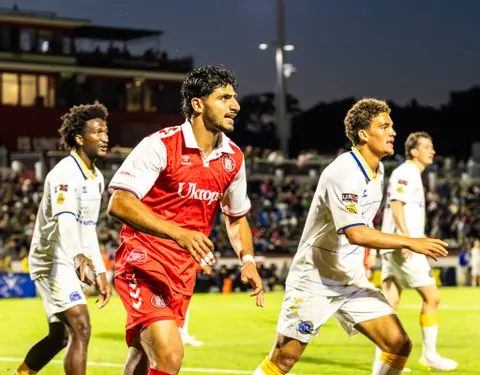
When rookie midfielder Ali Sasankhah signed with the Richmond Kickers this year on March 6 — one day before the team’s start of the regular season — he not only entered one of the most demanding stretches of a soccer player's season, he also had a host of other things to contend with as he began his pro career.
That’s because in addition to adjusting to a new club, competing for playing time, moving to a new city, and preparing for his first professional season, Sasankhah — a practicing Muslim — was also directly in the middle of observing Ramadan.
“It was definitely tough, I’m not going to lie,” Sasankhah said. “Preseason is already one of the hardest parts of the year, so doing it while fasting adds another level to it. But at the same time, it felt rewarding knowing I was pushing myself physically while staying committed.”
“It’s About Staying Consistent No Matter the Circumstances”
The holiest month in Islam, Ramadan is observed by Muslims around the world as a time of fasting, prayer, reflection, and community. From dawn until sunset, those who are fasting do not eat or drink — including water.
Additionally, because Ramadan follows the lunar calendar, its dates change each year. In 2026, it was observed from February 17 through March 18, which coincided with Richmond's preseason and early season. That means that Sasankhah had to balance the physical demands of training while observing Ramadan.
Fortunately for Sasankhah, this wasn’t his first go-around juggling his stated profession and his faith.
“Yeah, I’ve experienced it before, so I kind of knew what to expect. It definitely helped me prepare better this time, especially with managing my body and recovery.”
The recovery part was not easy.
“Probably the dehydration and low energy, especially during intense sessions,” he said when discussing his biggest physical challenge. “When you can’t drink water all day and you’re training at a high level, you really feel it.
“Sleep can be a bit different because of [pre-dawn meal] suhoor and late nights, so I try to nap when I can,” he continued. “Hydration is huge, too. I make sure I’m drinking a lot of fluids between [post-sunset meal] iftar and suhoor to stay ready for the next day.”
Staying Physically — and Mentally — Prepared
But the challenges aren’t just physical. He admitted they’re also mental, too.
“It’s all mindset. I remind myself why I’m doing it, and I try to stay present in the moment. Honestly, Ramadan teaches discipline, so I use that to push through training as well.”
That discipline has seemed to pay off for the 6’2” Northern California native, as his Kickers career got off to a quick start. After dressing (but not playing) against AV Alta in Richmond’s USL1 road opener — which took place one day after signing his contract — Sasankhah made his professional debut 10 days later in a U.S. Open Cup match at City Stadium against Northern Virginia FC, subbing off the bench and playing the final 25 minutes in the Kickers’ 1-0 victory.
Since that time, Sasankhah has made 10 starts in all competitions, playing over 900 minutes and picking up his first professional point with an assist in a win against Omaha in April.
While preparing for his first pro season during Ramadan definitely wasn’t ideal, he noted that it comes with some advantages, too.
“For me, it’s a time to reset mentally,” Sasankhah said. “As a person, it brings me closer to my faith. As a player, it builds discipline, patience, and mental toughness all things that help me on the field.
“I try to be smart with my energy. I don’t waste movements and I focus more on being efficient in training. Off the field, I make sure I’m resting more and really maximizing the time I have after I break my fast to recover.
For Sasankhah, that preparation — along with an assist from his teammates and coaches — was the key.
“(Team support) means a lot,” he continued. “Just them understanding what you’re going through and supporting you makes a big difference. Even small things like adjusting training times or checking in on you go a long way.”
He’s also got some words of encouragement for other young athletes who may find it difficult to balance playing competitive sports while observing the holiest month in Islam.
“I’d say stay disciplined and trust yourself,” he said. “It’s not easy, but it’s definitely possible. Take care of your body, listen to it, and don’t use fasting as an excuse, use it as motivation to be stronger mentally and physically.
— By Paul Silder
Know Your Enemy: AV Alta FC, Round Two
The Kickers return home this weekend looking to snap a 10-match winless streak that has produced just two points. Sitting uncomfortably close to the bottom of the table, they'll host AV Alta FC on Saturday. It's the second meeting between the sides…
New Faces, Fresh Challenges: Kickers Sign Two Players Amidst Slide
Looking to spark an attack that has struggled for consistency, the Richmond Kickers announced the signing of two experienced players over the past week. The first addition was forward Zahir Vazquez, a 26-year-old league veteran who most recently pl…


